



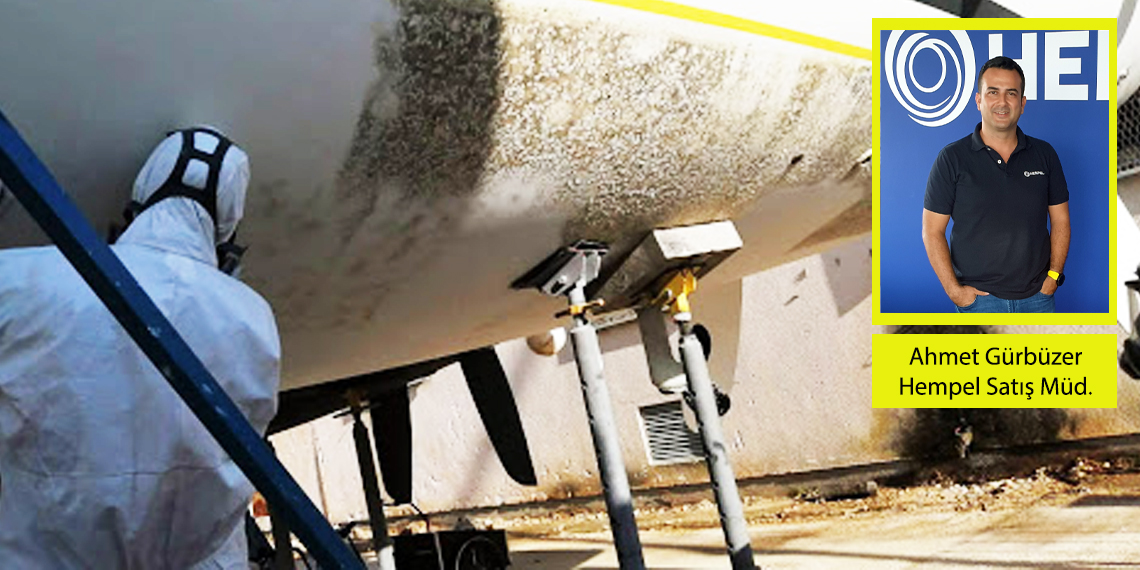
I seem to hear those who say extra expense, but the truth of the matter is unfortunately not so. Most of the boat owners and people who are dedicated to this business are aware of this issue, but unfortunately, our sailors are confused with too much information pollution. As we remember from our biology lessons, our dear teachers used to talk about some activities within the cell. Here is what he was talking about Osmosis,It is the passage of solvents from a very dense medium to a less dense medium through a selectively permeable membrane without the expenditure of energy. In fact, this phenomenon is valid not only in the cell but also in the marine industry for boats with unprotected or damaged fiber structure. The fiber structure that takes water begins to spread between the fiber layers over time and salty sea water causes damage to the resin structure. Composite boats that encounter this situation lose their hard structure over time and suffer deterioration. ’When water enters the fiber, it is unpredictable where it will go,’ said my dear classmate Mustafa, who taught me this job.( He is still engaged in composite work, so it has actually become his profession. Most of the time, if there is still a place where I still get stuck, I wear his door. He never spares his knowledge, thanks to him, he always helps). He is also very right, water seeps into the fiber through every gap between the small fiber particles and progresses to the end by spoiling it. Until an expert sees this problematic place and treats it. The treatment of osmosis is not very troublesome, a competent master opens the easily broken place, waits for a few days for the inside to dry and starts to lay fiber there again. Then he levels it and restores its integrity with the old structure. But the problem is to find the experts...., composite work is not as easy as it looks from the outside. So the main thing to do is to protect our boat before it gets sick.
So how should this protection be done, what if the boat does not encounter this problem, let's talk about it briefly. Boats can be made of many materials, the most common one is fiber / composite boats today. Depending on the production method of the boat you buy, they are manufactured either by hand lay-up or vacuum infusion method. Taking the necessary precautions before the boats meet the sea, which is the most challenging natural condition, will help you to prevent osmosis in the hull for many years. Paints that act as a barrier and do not contain solvents provide protection within the boat for many years as they reduce water permeability to a minimum (minimum). It is easier to do this job on new boats, the gel coat is removed with a fine sandpaper, the required barrier paint is applied to the surface min. 300 microns, then the binder antifouling paint is applied. For the boat that we have been using for a certain period of time, this process can be easily applied after a good leveling is done on the underwater hull part.
Many boats I have come across have suffered from the wrong choice of antifouling products and the roots of shellfish have damaged the hull structure. Therefore, it has already prepared the environment for osmosis to occur in the hull shell. In addition, to a considerable extent, boats have suffered from osmosis by taking water not from the outside but from the inside, that is, from the bilge, and this situation is often noticed when the boat is at the level of puncture. Nobody wants a hole in their boat, right? Personally, I certainly don't. That is why the osmosis protection of the boat should never be considered as an extra expense. Just as a boat needs a propeller to sail, painting the boat in the right system will help you to use that boat comfortably for many years and roads.
Celebrating its 106th anniversary on July 4th, Hempel Boya has designed Hempel's High Protect II, which is used only for osmosis protection, to protect your boat from osmosis for many years with a thickness of 300 microns. Thanks to the absence of any solvent in its composition and the hard layer structure it forms on the surface after application, it provides superior protection in water permeability compared to other epoxy paints. Of course, epoxy paints containing solvents also provide protection, but they will not perform as well as products that specifically prevent this phenomenon. When your boat is painted with a good solvent-free product, it can be protected up to 10 roads. But this does not mean that I applied this paint, every year I had enough shellfish under my boat to run a mussel shop, and I still got osmosis despite the paint! Yes, if you use it this way and rely only on primer paint, this will not work, your boat will invite osmosis. Choosing the right antifouling paint always benefits you in most parameters. This will return to you as fuel savings, freedom of movement due to the clean hull, speed and pleasure. Paint selection and correct application is a job that requires expertise. For the right paint selection, always getting information from experts, not hearsay, will provide you with a more peaceful use at sea. I wish you good sailing by reminding you that life safety on the boat comes first.
Ahmet Gürbüzer
Hempel Sales Manager







 English