


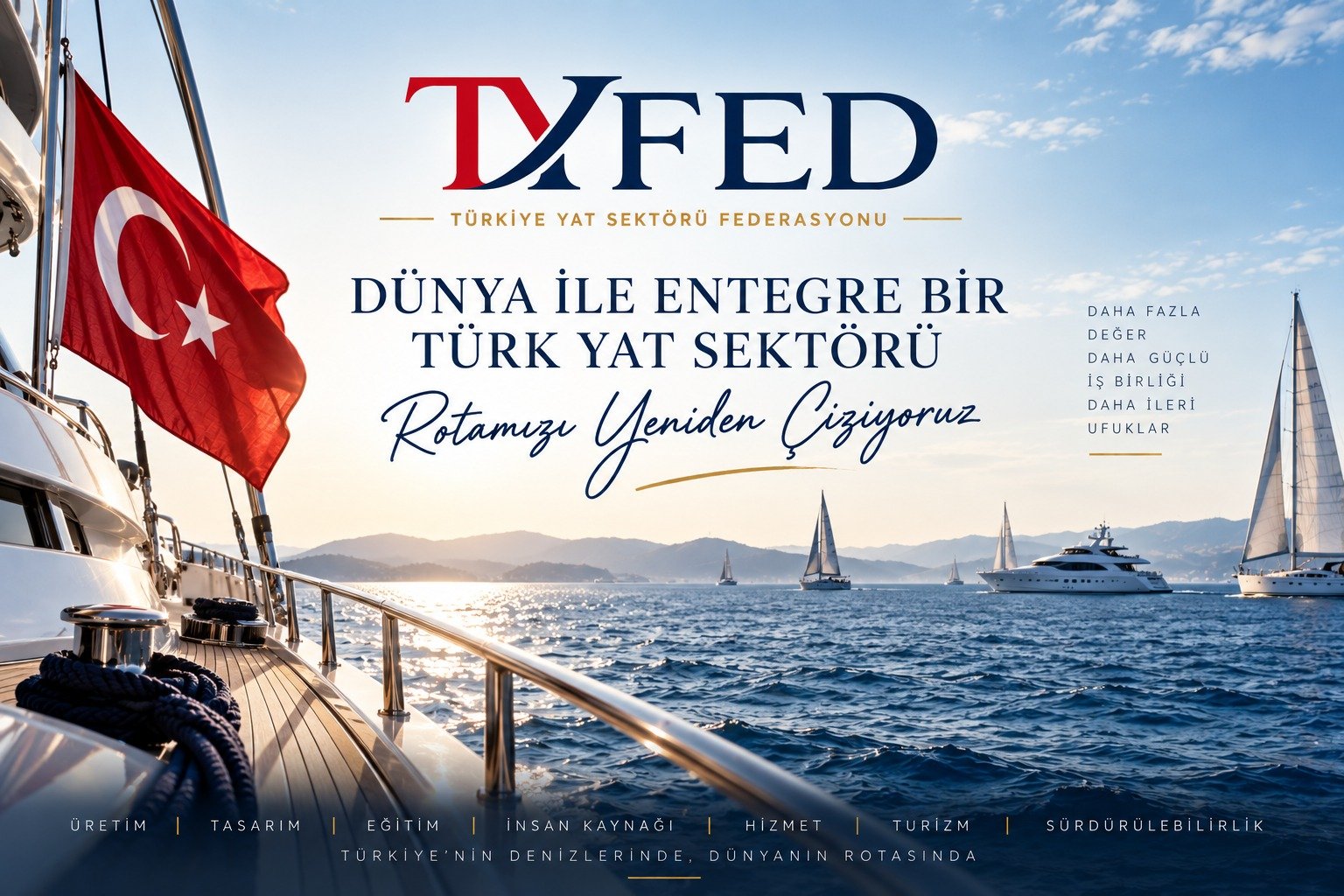
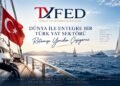
Eleven associations representing various sectors of the industry—from production to refit, yacht tourism to maritime education, and from professional yacht crew to brokerage, agency services, and the supply chain—have come together under the umbrella of the Turkish Yacht Industry Federation Initiative Group. The group, which is continuing its organizational efforts, has outlined a shared vision for the next 20–30 years of the Turkish yachting industry in its “Redrawing Our Course” declaration.
The level Turkey has reached in the yachting industry points to an economic and professional ecosystem that is now far too broad to be assessed solely by the number of boats produced or the number of shipyards in operation. Spanning from design and engineering to production, from maintenance and refit to marina management, and from charter operations to training and professional yacht crew, this structure is steadily strengthening Turkey’s position within the global yachting value chain.
Now, a new restructuring initiative aimed at bringing together different segments of the industry on a common ground is on the agenda.
As part of the efforts to establish the Turkish Yacht Industry Federation, 11 associations came together under the Turkish Yacht Industry Federation Founding Group. The Antalya Commercial Yacht Owners Association, the Bodrum Seafarers Association, the Gastro Yacht Chefs Association, the Izmir Boat Builders and Suppliers Solidarity Association, the Marmaris Seafarers and Captains Protection Association, the Private Maritime Education Institutions Association, the Professional Yacht Owners Association, the Association of All Yacht Operators, Yacht Brokers, and Agents, the International Yacht Industry Employees Association, the Authorized Onboard Training Association, and Young Professionals in Yachting Turkey—aims to bring together different areas of expertise within the yachting industry under a shared vision for the future.
The vision set forth by this partnership outlines a broader framework than short-term solutions to current problems. In the declaration titled “Redrawing Our Course,” the goal is to position Turkey not only as a strong manufacturing nation in the yachting industry but also as an international hub that designs, manages, provides services, trains human resources, and is the preferred destination for yachts worldwide.
“We want to turn Turkey into a strong international hub that not only manufactures yachts but also designs them, manages them, provides services for them, trains the workforce, and serves as a base for yachts from around the world.”
An approach that pushes the boundaries of the industry
Turkey’s strength in yacht production has now reached a position that is recognized on a global scale. In addition to Turkish shipyards, designers, engineers, equipment manufacturers, artisans, and numerous specialized service providers are involved in international projects. In the maintenance and refit sector as well, Turkey is emerging as one of the leading centers, particularly in the Mediterranean basin.
However, the starting point of the federation initiative goes beyond this very strength: it lies in the ability to assess Turkey’s production and service capabilities as a unified whole in terms of international representation, joint promotion, legislation, education, certification, and increasing the economic value generated within the country.
For this reason, the federation views the yachting industry not as the sum of separate sectors, but as a value chain in which each component supports the others. A shipyard’s production capacity, a design firm’s expertise, a marina’s infrastructure, a charter fleet, a brokerage network, or a team of trained captains and crew are all viewed as different links in the same economic chain.
This perspective suggests that Turkey’s future yachting policy should also be addressed on a more holistic basis.
The declaration’s long-term perspective takes on particular importance here. The goal is not merely to resolve current issues, but to define today the position Turkey will hold in the global yachting industry over the next 20–30 years.
A 20- to 30-year perspective
The Oluşum Group’s approach centers on the idea of a comprehensive master plan for yachting in Turkey. It is emphasized that various topics—ranging from marinas to mooring and dry-docking areas, from shipyards to production zones, and from charter and winter storage activities to coastal use—must be evaluated within the framework of long-term planning rather than through isolated decisions.
The goal here goes beyond simply building more yachts.
Turkey is not merely a destination along the route for yachts from around the world, but, home port, maintenance and refit, winter storage, charter, and lifestyle center It is hoped that this model will be chosen. Such a model is also expected to expand the direct and indirect economic impacts of yachting.
When a yacht stays in Turkey for a longer period, it does more than just boost marina revenue. Numerous sectors—including fuel, provisions, technical services, maintenance, logistics, lodging, crew services, gastronomy, and tourism—benefit from this activity. Consequently, the model proposed by the federation also views yachting as a high-value-added service economy.
Another pillar of this approach is international representation.
In an environment where Turkey’s visibility on the global yachting stage is largely shaped by the success of companies and individual brands, the goal is to represent the sector with a unified identity. Among the roles the federation intends to assume is the more coordinated promotion of Turkey’s production and service capabilities at international trade shows, decision-making platforms, and target markets.
In addition, human resources is also addressed as one of the strategic priorities. It is noted that training, certification, foreign language skills, and professional competency standards must be improved to enable Turkish captains, engineers, chefs, stewardesses, and other yacht professionals to secure stronger positions in international fleets.
This perspective also positions Turkey’s human resources in the yachting industry as a strategic asset with export potential.
The relationship between the public sector and the industry is also being reevaluated within this framework. Among the items on the federation’s agenda are the creation of a predictable and competitive regulatory framework that takes into account the unique operational structure of the yachting industry, and the development of tax, incentive, charter, and operational policies in line with the realities of the industry.
Turning Turkey into a yachting hub
The common thread running through all these topics is increasing Turkey’s share of the global yachting economy.
Turkey’s geographic location, shipyard infrastructure, technical expertise, labor force capacity, and coastline opening onto the Mediterranean provide a significant advantage for this goal. However, the federation’s approach is based on the idea that these advantages will not automatically translate into economic superiority.
It is necessary to address, within the same system, opportunities for longer-term winter storage, enhanced refit capabilities, marina and dry-dock infrastructure, support for charter operations, a qualified workforce, and legislation that complies with international standards.
The environmental aspect of this model is also not overlooked in the strategy. The protection of the natural and cultural values of the Aegean and Mediterranean coasts, the planning of coastal use in a manner consistent with carrying capacity, and the development of yachting infrastructure within a sustainable framework are all considered alongside the goal of economic growth.
Turkey’s future identity in the yachting industry is thus intended to be defined not only by its production volume, but also by how it manages its coastlines, how it develops its human resources, and how much value it can generate from the global yachting economy.
Another point highlighted by the federation initiative is the role of existing associations and institutions. The Founding Group states that the new structure is not intended to replace existing organizations; rather, it aims to create a stronger collective voice on common issues while preserving diverse areas of expertise and regional representation.
This approach is clearly stated in the declaration:
“The Turkish Yacht Industry Federation was not established to replace any existing organization; rather, it was founded to speak with one voice on common issues while preserving our differences.”
From this perspective, the process of establishing TYFED is not viewed merely as the emergence of a new professional organization. It also represents an effort to define the various stakeholders within the Turkish yachting industry as a unified economic entity and to develop a longer-term perspective on the sector’s future.
Turkey’s current standing in the yachting industry is the result of a strong manufacturing infrastructure. The next step could be to integrate this strength more effectively with design, refit, tourism, marina management, education, human resources, and the international service economy.
The declaration put forward by the TYFED Initiative Group, therefore, looks far beyond today’s industry agenda. It outlines a framework for how Turkey aims to become a hub in the global yachting industry—not just over the next few trade show seasons or business cycles, but over the next few decades.
The closing remarks of the declaration also summarize this long-term approach:
“We won’t settle for merely managing today’s challenges. Together, we will shape the future of Turkey’s yacht industry. Our course is set for the world. Our bow points forward.”



 English